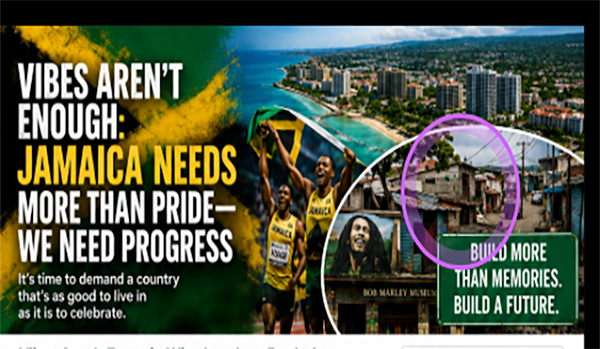
Editorial Note: Where This Conversation Began
This editorial grew out of a conversation on r/Jamaica sparked by a post titled “Am I the only one a little exhausted by Jamaican patriotism?”
The question was provocative, but the underlying argument was not an attack on Jamaica or Jamaican pride. The original poster acknowledged Jamaica’s extraordinary global reputation in music, athletics, food, and culture while asking whether we should be equally focused on making Jamaica a place that is safe, inclusive, beautiful, functional, and genuinely caring for its people.
That question resonated with me because it goes beyond patriotism as an emotion. It raises a much larger issue: What should loving Jamaica actually require of us?
Should patriotism mean celebrating when our athletes win, defending Jamaica whenever it is criticized, waving the flag, and proudly telling the world how much we love our country?
Or should patriotism also give us the courage to say:
We can do better.
Our infrastructure should be better.
Our economy should be stronger.
Our communities should be better developed.
Our leaders should be held to a higher standard.
This editorial expands on that Reddit conversation through my own observations about Jamaican development, infrastructure, economic priorities, tourism dependency, leadership, and the tendency to celebrate what Jamaica is rather than demand what Jamaica could become.



The argument is not against Jamaican patriotism. It is an argument for a more demanding form of patriotism—one that doesn’t simply celebrate Jamaica, but insists on building a better Jamaica
This article was inspired by a conversation on r/Jamaica.
A recent discussion on Reddit posed a provocative question: “Am I the only one a little exhausted by Jamaican patriotism?”
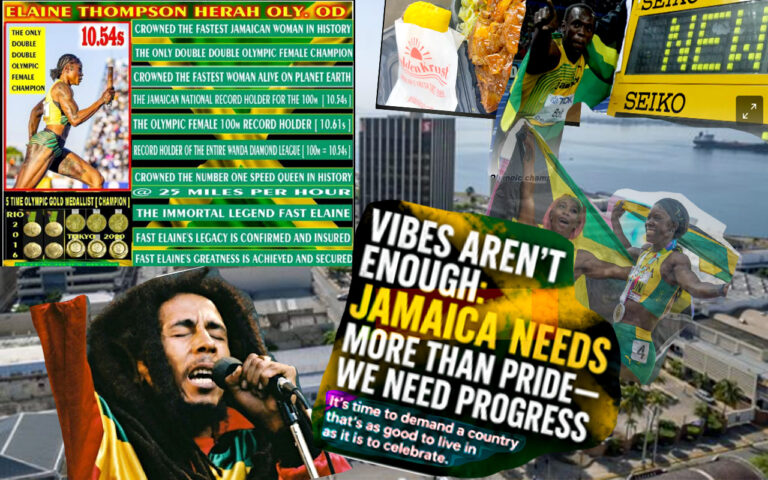
The original poster wasn’t arguing that Jamaicans should stop loving their country. Quite the opposite. The argument was that Jamaica’s extraordinary achievements in music, athletics, food and culture should not become an excuse to overlook the country’s shortcomings.
The point was simple: Jamaica should be a place that is not only celebrated around the world, but also genuinely worth living in.
That distinction deserves serious consideration.
I agree.
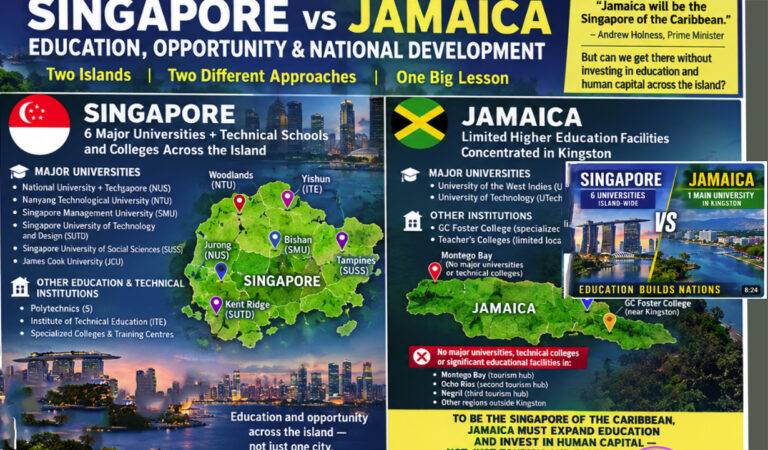
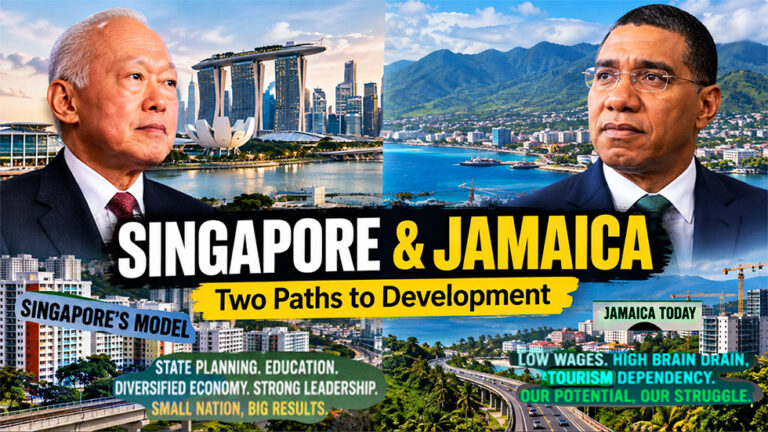
As I said in another discussion, sometimes I find myself thinking that I would rather Jamaica had adopted more of the developmental mindset associated with countries such as Singapore—not culturally, but in terms of discipline, infrastructure, economic planning, institution-building and collective ambition.
Jamaicans punch dramatically above our weight in sports, music and entertainment. We have produced global icons, world-class athletes and cultural movements that have influenced the planet.
But there is a glaring contradiction.
Why have we been so successful at producing individual excellence while struggling to reproduce that success collectively?
We can produce Olympic champions.
We can produce internationally recognized musicians.
We can create global cultural trends.
We can attract millions of visitors.
But when it comes to infrastructure, manufacturing, technological innovation, productivity, public transportation, housing and broad-based economic development, the results are far less impressive.
That should bother us.
The Problem With “Vibes and Hype”
Sir P from Politricks Watch once described the Jamaican mentality in a way that stuck with me:
“Iriemon just love to have a vibe and love the hype.”
There is truth in that observation.
We love the celebration.
We love the spectacle.
We love being recognized.
And there is absolutely nothing wrong with that.
The problem begins when celebration replaces expectation.
We celebrate Jamaica’s accomplishments so enthusiastically that sometimes even suggesting that Jamaica could have done better is interpreted as an attack on Jamaica itself.
That is backwards.
Criticizing Jamaica because you want better for Jamaica is not anti-Jamaican.
In many cases, it is one of the most patriotic things you can do.
The IShowSpeed Visit Exposed the Contradiction
This became particularly obvious to me during IShowSpeed’s visit to Jamaica.
There was an enormous amount of excitement surrounding the visit. Social media was filled with people celebrating Jamaica’s appearance and proclaiming how proud they were of the country.
I remember seeing a young Jamaican—who, as I understood it, did not even live in Jamaica—become emotional while declaring his love for the country.
That emotion was genuine.
And I understand it.
Jamaica means something profound to many of us, whether we live there or in the diaspora.
But then came the claims that Jamaica had delivered the best showing.
I disagreed.
I pointed out that Jamaica didn’t necessarily have the best presentation. The Bahamas and the Dominican Republic, in my view, had advantages because they could showcase stronger infrastructure and more developed public spaces.
That shouldn’t have been controversial.
It wasn’t an insult to Jamaica.
It was an observation about infrastructure.
Yet when I turned that observation into an article for Philly Yardy Vibes and shared it on my Facebook page, the reaction was intense.
I received hundreds of negative comments, including plenty of personal insults.
Apparently, saying “we can do better” was interpreted by some as saying “Jamaica is worthless.”
Those are not the same thing.
What Are We Actually Showcasing?
I also questioned what parts of Jamaica were being showcased.
We saw portions of Kingston.
We saw the Bob Marley Museum.
And we saw poorer communities.
There is nothing inherently wrong with showing any of these places. Jamaica’s reality includes all of them.
But shouldn’t we also be asking why a country with Jamaica’s global reputation doesn’t have more world-class public spaces, modern infrastructure and well-developed communities that can be showcased proudly?
Why shouldn’t Kingston have more?
Why shouldn’t Montego Bay have more?
Why shouldn’t Spanish Town have more?
Why shouldn’t rural Jamaica have more?
Why shouldn’t ordinary Jamaican communities have the same investment and attention that we give to tourism enclaves?
Why are we so easily satisfied with what exists instead of demanding what could exist?
Patriotism Should Not Mean Lowering Our Expectations
The Reddit discussion is important because it separates two things that are often treated as identical:
loving Jamaica and defending everything about Jamaica.
They are not the same.
You can love Jamaica and criticize its government.
You can love Jamaica and demand better roads.
You can love Jamaica and question the country’s economic model.
You can love Jamaica and criticize inadequate housing.
You can love Jamaica and demand better public transportation.
You can love Jamaica and question why so much of the economy remains dependent on tourism.
You can love Jamaica and ask why young people feel they have to leave to find opportunities.
In fact, if we truly love Jamaica, shouldn’t we be demanding more?
The original Reddit poster made essentially this argument: Jamaica should not merely be famous; it should be safe, inclusive, beautiful, functional and caring toward its own people.
That is a reasonable standard.
Why Can We Punch Above Our Weight Individually But Not Collectively?
This is perhaps the bigger question.
Jamaica’s individual achievements are remarkable.
Our athletes consistently compete at the highest level.
Our musicians have shaped global culture.
Our food has become internationally recognized.
Our language, fashion, dance and cultural expressions have influenced people far beyond our shores.
But cultural influence doesn’t automatically translate into economic power.
We have to build systems that convert talent into productivity.
We need infrastructure that supports businesses.
We need educational institutions that produce innovation.
We need industries that create value beyond tourism.
We need investment that reaches communities rather than concentrating around enclaves.
We need leaders who think beyond the next election cycle.
And most importantly, we need citizens who demand these things.
The Singapore Question
This is why I made the comparison with Singapore.
I’m not suggesting Jamaica should become Singapore.
Jamaica has its own history, culture, geography and social realities.
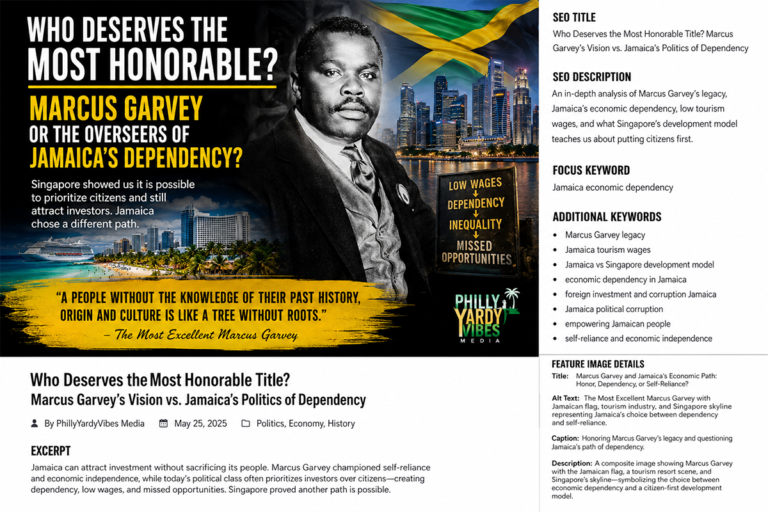
But Singapore demonstrates what can happen when a country places extraordinary emphasis on infrastructure, planning, education, institutions, investment and economic development.
Jamaica has demonstrated that we can produce extraordinary people.
The question is whether we can produce extraordinary systems.
That’s where the gap lies.
We Don’t Lack Talent. We Lack Collective Ambition.
This brings me back to patriotism.
Perhaps our problem isn’t that Jamaicans are too patriotic.
Perhaps our problem is that our patriotism isn’t demanding enough.
We celebrate the athlete after they win.
But do we ask why the next generation has to train on inadequate facilities?
We celebrate the musician after they become successful.
But do we ask why our creative industries aren’t generating more sustainable wealth?
We celebrate tourism arrivals.
But do we ask how much of the value generated actually remains within Jamaican communities?
We celebrate the country when foreigners praise it.
But do we ask whether ordinary Jamaicans can afford to live comfortably in the country being praised?
These questions aren’t anti-Jamaican.
They are pro-Jamaica.
We Keep Talking About Leaving
And then there is the other part of the Jamaican conversation that rarely gets enough attention.
When people become frustrated with the country, the common solution is often:
Leave.
Go to America.
Go to Canada.
Go to England.
Go somewhere else.
And I understand why people do it. People want opportunity, security and a better quality of life.
But imagine if the same energy we put into escaping Jamaica was sometimes redirected toward transforming Jamaica.
Imagine if the brightest minds who leave were also able to build industries at home.
Imagine if our diaspora wealth, knowledge and connections were systematically channeled into Jamaican businesses and communities.
Imagine if Jamaicans demanded as much from their leaders as they demand from themselves when trying to migrate.
Maybe the goal shouldn’t simply be to escape the plantation.
Maybe we should also be asking how to dismantle the structures that keep reproducing it.
And perhaps we need to stop treating political leaders as untouchable figures who deserve loyalty regardless of performance.
We need citizens, not cheerleaders.
From Overseers to Leaders
For generations, Jamaica has struggled with systems shaped by colonialism, class divisions, economic dependency and political tribalism.
Independence changed the flag.
It changed who formally occupies the offices of power.
But changing the faces at the top is not enough.
We need a transformation in how leadership itself is understood.
Our leaders should not behave like overseers managing a population.
They should behave like leaders building a nation.
And citizens should not be satisfied simply because someone speaks with a Jamaican accent, wears the national colors or tells us how much they love Jamaica.
Show us what you are building.
Build the roads.
Build the schools.
Build the housing.
Build the industries.
Build the infrastructure.
Build the institutions.
Build opportunities.
Build a country where leaving is a choice—not a necessity.
Patriotism Should Be a Demand, Not Just a Feeling
The Reddit conversation that inspired this article ultimately raises a question far bigger than whether Jamaicans are too patriotic.
It asks what patriotism should actually mean.
Is patriotism simply getting emotional when Jamaica wins?
Is it waving the flag?
Is it defending Jamaica whenever someone criticizes it?
Or is patriotism also having the courage to say:
This isn’t good enough.
We can do better.
Our people deserve better.
Our children deserve better.
I believe the latter is the more meaningful form of patriotism.
Jamaica has already proven that it can produce world-class talent.
Now we need to prove that we can build a world-class society.
We don’t lack talent.
We don’t lack culture.
We don’t lack creativity.
We don’t lack global recognition.
What we lack is the collective determination to turn those strengths into lasting economic and social power.
The plantation was never simply about the crops.
It was about the structure.
And if we genuinely want a different Jamaica, we have to do more than celebrate the country.
We have to build it.
come and join me at moomoo!Sign up via my referral link now and claim 8.1% APY and up to 15 free stocks!
account when you invite 3 or more friends to sign