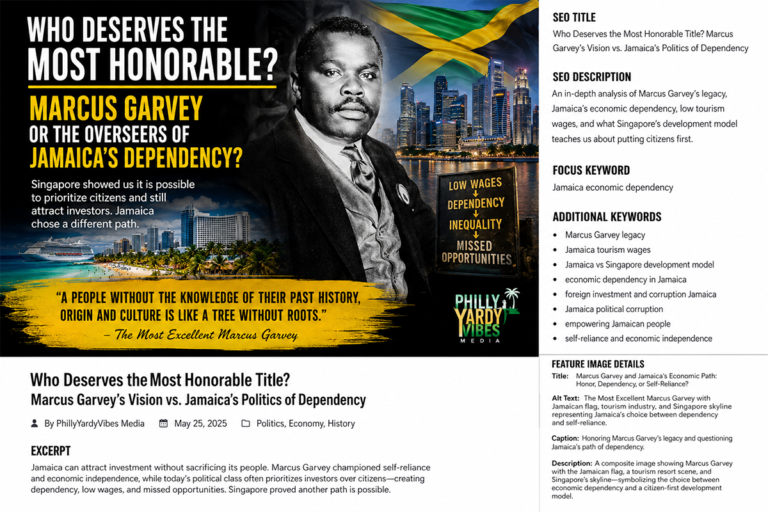
Excerpt
Singapore is frequently presented as a model of free-market success.
Its economy is highly open to international trade, foreign investment, and private enterprise. Yet Singapore’s development story cannot be explained by free markets alone.
The Singapore government has maintained a substantial role in land management, public housing, infrastructure, education, industrial policy, and strategic investment.
That creates a more complicated picture.
Singapore is not simply a story of capitalism replacing government intervention. It is a story of a state using significant institutional power while simultaneously building an economy that competes aggressively in global markets.
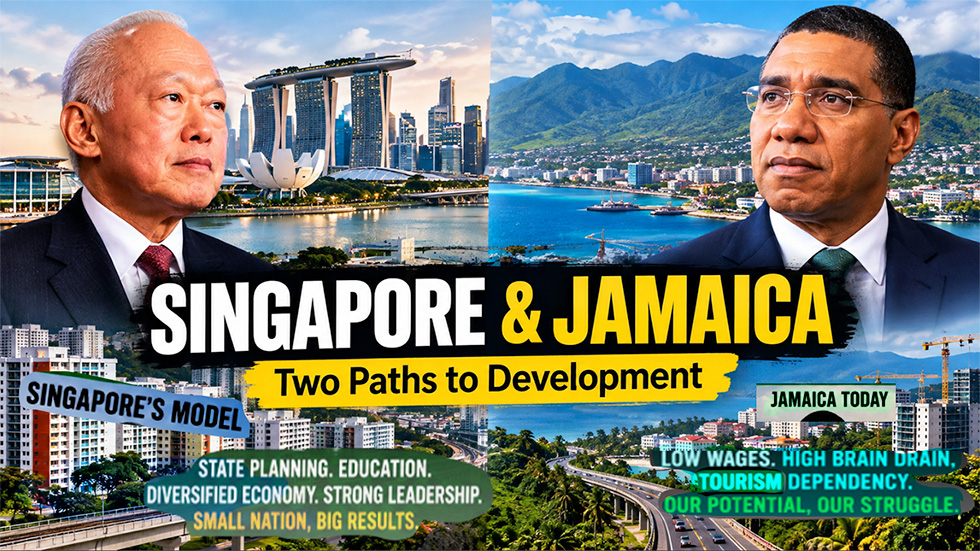
That distinction matters when Jamaican politicians, economists, and commentators point to Singapore as a development model.
The question is not whether Jamaica should become another Singapore.
The more useful question is:
What did Singapore actually do to transform its economy, and which elements—if any—could Jamaica adapt to its own circumstances?
Singapore’s Development Model Was Never Simply “Free Market”
Singapore became independent in 1965 facing serious economic challenges, including unemployment, poor housing conditions, and a relatively unskilled workforce.
The government responded with a deliberate strategy of industrialisation, infrastructure development, education, skills training, and attracting foreign investment.
According to the World Bank, Singapore’s economy has averaged about 7 percent annual growth since independence, with manufacturing becoming a major driver of its transformation before services became an equally important pillar of the modern economy.
This did not happen because the government simply stepped aside and allowed the market to take over.
The state actively shaped the environment in which the market operated.
That included land.
It included housing.
It included education.
It included infrastructure.
And it included institutions that helped attract and retain international investment.
This is one reason the Singapore experience is often discussed in terms such as state capitalism, although Singapore itself does not define its economic system through that label.
1. Singapore Used State Control of Land as a Development Tool
Land is one of Singapore’s most important strategic assets.
The Singapore Land Authority says it manages approximately 11,000 hectares of State land and around 2,600 State properties. The government also describes State land as a shared national resource that is managed for public purposes and, when sold, transferred at fair market value.
This matters because land policy affects much more than real estate.
It affects housing.
Industrial development.
Transportation.
Public facilities.
Commercial activity.
And the physical shape of the country.
Singapore therefore had a powerful tool for coordinating national development.
Rather than leaving all land-use decisions to fragmented private interests, the state retained substantial control over a scarce national resource.
That does not mean every parcel of land is simply owned and operated directly by the government. Singapore also grants leases and allows private ownership interests.
But the state’s position gives it considerable influence over long-term land use.
2. Public Housing Became Part of Economic Development
Perhaps the most visible example of Singapore’s intervention is housing.
Singapore’s Housing & Development Board says about four in five Singaporeans live in HDB flats, and roughly 90 percent of those HDB households own their homes.
That is a very different approach from treating public housing purely as a temporary safety net.
Singapore used housing policy as part of a broader social and economic strategy.
Millions of citizens were brought into a system of subsidised public housing and home ownership.
The result was not simply a roof over people’s heads.
Home ownership became connected to household wealth, social stability, and a sense of participation in the country’s development.
This was one of the important ideas associated with Lee Kuan Yew’s vision for Singapore.
The broader lesson is that public policy can shape the distribution of economic opportunity through housing—not only through wages and employment.
3. Singapore Also Built State-Linked Capital
Another major part of the Singapore model is the role of government-linked companies and state investment.
Temasek was established in 1974 to commercially manage a portfolio of companies that had previously been held by the Singapore government.
Today, Temasek remains wholly owned by the Singapore Minister for Finance.
As of March 31, 2026, Temasek reported a net portfolio value of S$518 billion. Its portfolio includes investments across sectors and countries, including major Singapore-based companies.
This is important to the Singapore comparison.
The country did not simply say:
“Government should own nothing.”
Instead, the Singapore state created institutions capable of holding and managing strategic assets on a commercial basis.
At the same time, Singapore continued to welcome private companies and multinational corporations.
The result was a system in which state-linked capital and private capital operated alongside one another.
4. Singapore Did Not Reject Foreign Investment
This point is especially important for Jamaica.
Singapore’s development did not depend on turning away foreign investors.
It did almost the opposite.
The country aggressively pursued foreign direct investment and used its infrastructure, workforce, political stability, and institutions to make itself attractive to multinational corporations.
The World Bank has described Singapore’s strategy as combining foreign direct investment with education, technical skills, infrastructure, and government-linked companies operating on commercial principles.
This distinction is crucial.
Foreign investment was not treated as the entire development strategy.
It was used as part of a larger strategy for industrialisation and upgrading.
Singapore wanted international companies to bring capital, technology, markets, and employment.
At the same time, the government invested in the conditions needed for Singapore’s population and domestic economy to participate in that growth.
That is a very different question from simply asking:
How much foreign investment did the country attract?
The deeper question is:
What capabilities did the country build around that investment?
5. Education and Skills Were Central to the Singapore Model
Singapore also made education and workforce development a central part of economic policy.
The country had limited natural resources.
Its greatest long-term asset was its people.
The World Bank’s historical research on Singapore describes the government’s emphasis on education, technical training, infrastructure, and industrial development as interconnected parts of the country’s economic strategy.
As Singapore moved from low-value activities toward manufacturing and eventually higher-value services, its education and training systems were adapted to support those changes.
That meant development was not viewed simply as building roads, ports, and factories.
It also meant building the people capable of working in those factories, managing those companies, designing those systems, and operating a modern economy.
That is one of the most important parts of the Singapore story.
6. What Does This Mean for Jamaica?
This is where the Singapore-Jamaica comparison becomes more interesting.
Jamaica has attracted foreign investment and developed important industries, especially tourism, mining, financial services, logistics, and other services.
But attracting investment does not automatically guarantee that an economy becomes more productive, diversified, or broadly prosperous.
The International Monetary Fund’s 2025 assessment of Jamaica identified low productivity and several structural constraints, including poor educational outcomes, inadequate infrastructure, barriers to competition, crime, and trade barriers.
Those challenges affect the ability of businesses and workers to move into higher-value economic activities.
This is where Singapore provides an interesting comparison.
Singapore did not merely seek capital.
It invested heavily in the systems that allowed the country to absorb capital and turn it into productive economic capacity.
7. The Brain Drain Requires a More Careful Discussion
Jamaica also faces the long-running challenge of skilled migration.
The loss of educated and trained Jamaicans has been an important subject of economic and social research.
However, the statistics surrounding Jamaica’s brain drain are sometimes presented too simplistically.
The frequently repeated claim that “80 percent of tertiary-educated Jamaicans leave the country” requires qualification.
World Bank research has shown that many highly educated Jamaican migrants, particularly in the United States, obtained their tertiary education after leaving Jamaica. One analysis estimated Jamaica’s actual skilled migration rate at roughly 35 percent under the methodology used, rather than 80 percent.
That does not make skilled migration unimportant.
Quite the opposite.
It shows why the issue needs to be understood accurately.
A country that repeatedly loses nurses, teachers, professionals, technical workers, entrepreneurs, and other skilled people faces a difficult challenge in building domestic productive capacity.
The question then becomes:
How can Jamaica create enough opportunity at home for more of that human capital to remain, return, or invest back into the country?
8. Technocratic Institutions Were Another Part of Singapore’s Story
Singapore also developed a highly professional public administration.
Economic agencies and government institutions played major roles in industrial policy, infrastructure, education, housing, investment promotion, and urban planning.
The objective was not simply to announce policies.
It was to develop institutions capable of executing them.
This is another area where simplistic comparisons can become misleading.
Jamaica operates within a competitive multiparty democratic system with elections and changes in government.
Singapore developed through a much longer period of dominant-party governance under the People’s Action Party.
Those are fundamentally different political environments.
Therefore, Jamaica cannot simply copy Singapore’s political arrangements.
But Jamaica can still examine questions of institutional capacity, planning, professional administration, and policy continuity.
9. Long-Term Planning Made a Difference
Singapore’s development was also shaped by long-term planning.
Economic strategies evolved as the country changed.
Manufacturing gave way to higher-value manufacturing.
Services expanded.
Infrastructure was repeatedly upgraded.
Education and skills policy evolved with the labour market.
The World Bank describes Singapore’s transformation as a planned structural shift from entrepôt trade to manufacturing and eventually to a knowledge-intensive economy.
That matters because economic development is not achieved through one project.
It requires continuity.
A port alone does not create an industrial economy.
A hotel alone does not create a diversified economy.
A road alone does not create higher productivity.
Infrastructure becomes transformational when it is connected to education, industry, logistics, housing, technology, investment, and human capital.
10. Jamaica’s Development Challenge Is More Than Foreign Investment
This may be the biggest lesson from the Singapore comparison.
Jamaica does not necessarily need less foreign investment.
It needs to consider how foreign investment connects with domestic development.
When a new hotel is built, what local businesses benefit?
When a foreign company enters the country, how much knowledge and technology remain in the local economy?
When infrastructure is constructed, what industries can grow around it?
When tourism expands, how much value is retained within Jamaican communities?
And when government offers incentives to investors, what long-term economic capacity is created in return?
These questions do not reject foreign investment.
They ask how investment can contribute to broader national development.
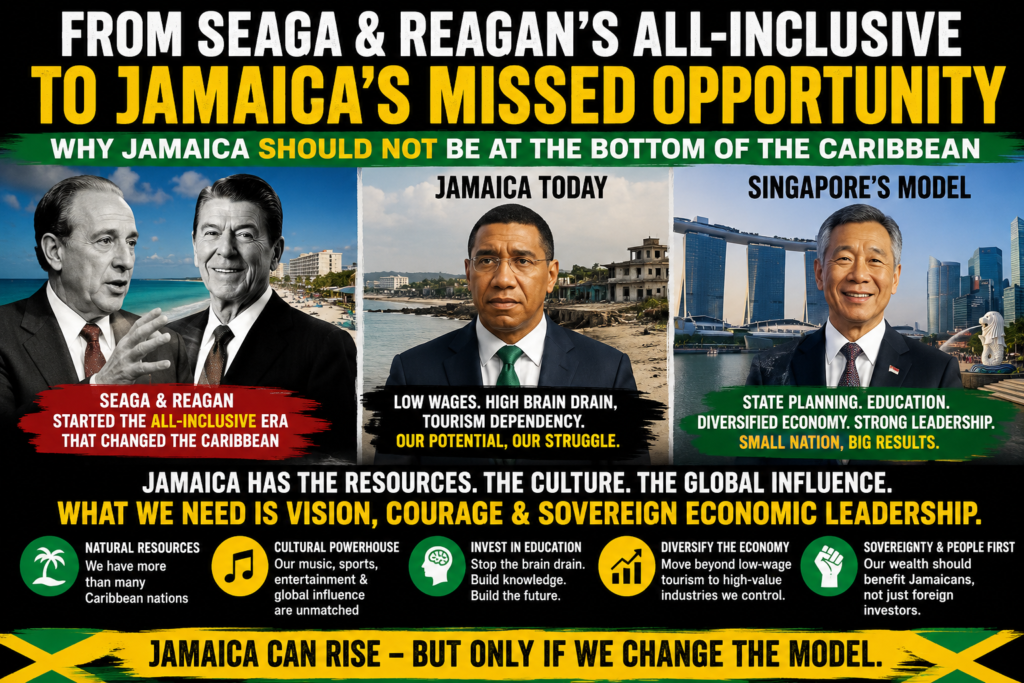
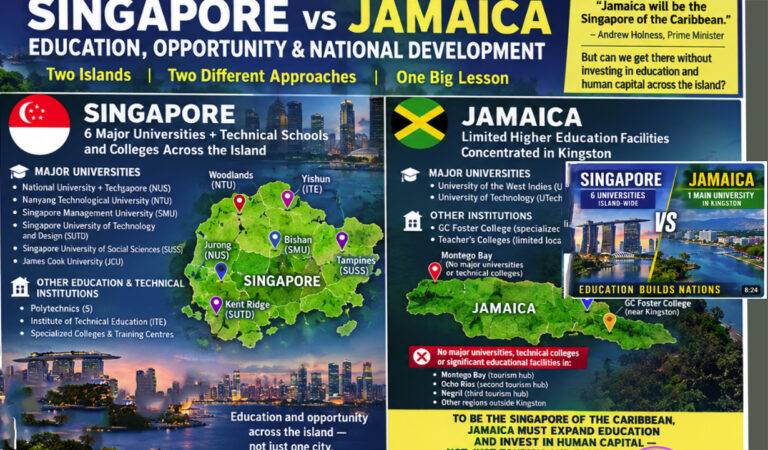
11. Beyond the “Singapore of the Caribbean” Slogan
Calling Jamaica the “Singapore of the Caribbean” may sound attractive.
But the phrase can become meaningless if it is reduced to lower taxes, attracting foreign investors, cutting government spending, or advertising Jamaica as a business-friendly destination.
Singapore’s transformation involved much more.
It involved land policy.
Public housing.
Education.
Technical training.
Infrastructure.
Industrial strategy.
Foreign investment.
State-linked capital.
And institutions capable of executing long-term plans.
This does not mean every Singapore policy should be imported into Jamaica.
Singapore is a small city-state.
Jamaica is an island country with a different geography, population, political structure, history, and economic base.
The purpose of the comparison should therefore be adaptation rather than imitation.
12. What Could Jamaica Take From the Comparison?
The useful lessons are structural.
First, public investment can support private-sector growth rather than simply compete with it.
Second, education and technical skills are economic infrastructure, not merely social spending.
Third, housing policy can influence wealth creation and social stability.
Fourth, foreign investment can be used as a vehicle for upgrading domestic capabilities, rather than being measured only by the size of the investment announcement.
Fifth, state-linked capital can be structured around commercial objectives, although the governance model and accountability arrangements matter enormously.
And finally, long-term development requires institutions capable of carrying policies beyond individual political cycles.
None of these ideas requires Jamaica to become Singapore.
They require Jamaica to think more deliberately about what kind of economy it wants to build.
Conclusion: Singapore and Jamaica Are Different—But the Comparison Still Matters
Lee Kuan Yew’s Singapore was not built by choosing between government and capitalism.
It was built through a particular combination of government intervention, market competition, foreign investment, public housing, education, infrastructure, strategic planning, and institution-building.
Singapore’s experience therefore complicates the idea that successful development requires the state to simply get out of the way.
At the same time, Singapore’s experience does not prove that heavy government intervention automatically produces prosperity.
The institutions, policies, political environment, execution, and historical circumstances all matter.
For Jamaica, the more important lesson may be this:
Investment is only the beginning of development.
The bigger challenge is turning investment into higher productivity, stronger institutions, better skills, greater economic diversification, and wider opportunities for Jamaicans.
That is why the Singapore comparison deserves a deeper discussion.
Not because Jamaica should become Singapore.
But because the question of how a country uses state power, private capital, human talent, and long-term planning to build national wealth remains central to Jamaica’s economic future.
And that is the real question behind the phrase:
“The Singapore of the Caribbean.”
come and join me at moomoo!Sign up via my referral link now and claim 8.1% APY and up to 15 free stocks!
account when you invite 3 or more friends to sign