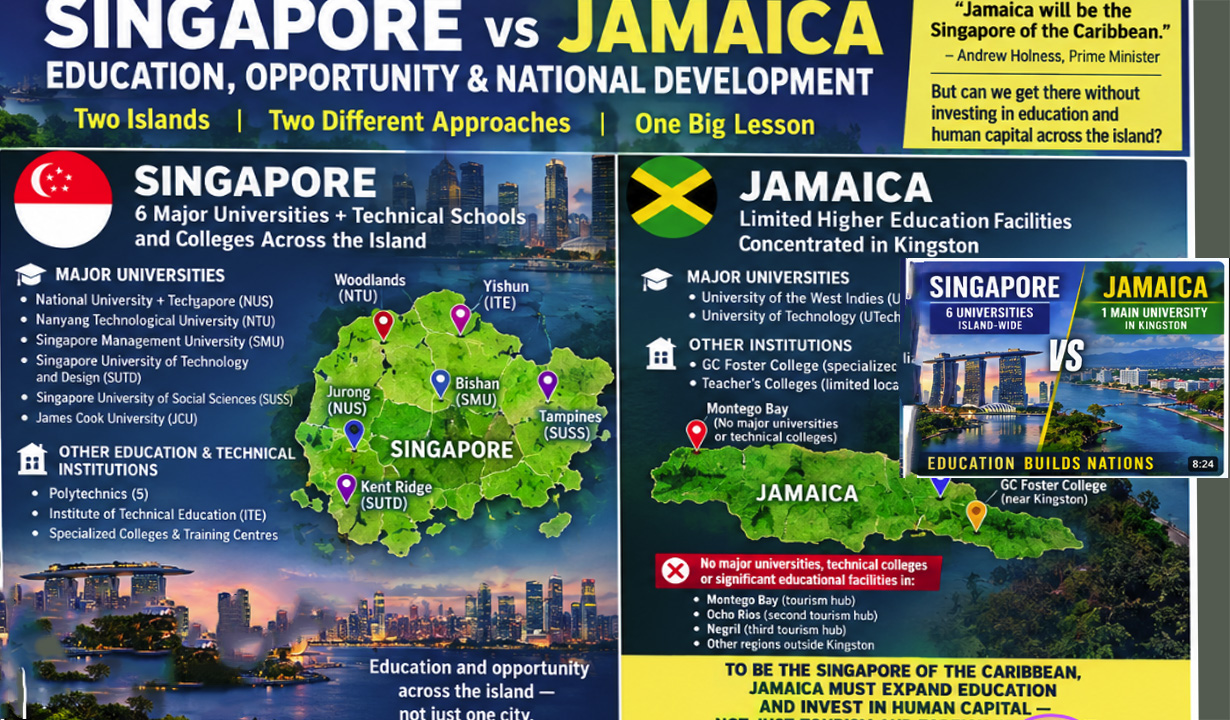
Prime Minister Andrew Holness has repeatedly presented a bold vision for Jamaica: Jamaica will become the Singapore of the Caribbean.
It is an ambitious statement.
But before accepting the slogan, perhaps we should ask a more important question:
Is Jamaica actually following the kind of development path that made Singapore successful?
Because becoming Singapore is about far more than attracting foreign investors, building luxury developments and expanding tourism.
Singapore invested heavily in education.
It developed universities, polytechnics, technical institutions and specialized training across the island.
It built human capital.
It created infrastructure designed to support productivity, technology, manufacturing, research and innovation.
And it deliberately developed a highly skilled population capable of participating in—and benefiting from—the country’s economic transformation.
So where does Jamaica fit into that picture?
Jamaica’s major universities remain heavily concentrated around Kingston.
The University of the West Indies and the University of Technology are both located there.
Meanwhile, Montego Bay—the country’s second city and one of its most important economic centres—still lacks a major university and the kind of broad educational and research infrastructure that could transform the city into a major knowledge and technology hub.
Ocho Rios and Negril face similar questions.
This matters because economic development follows infrastructure and human capital.
If universities, research institutions, technical schools, major hospitals, sports facilities, technology centres and other major institutions remain concentrated in one part of the country, then opportunity becomes concentrated there as well.
And this is where the Holness vision deserves serious scrutiny.
The government’s development model has placed considerable emphasis on tourism, attracting foreign investment, investor confidence and large-scale development.
Those things have a place in Jamaica’s economy.
But they cannot be the entire development strategy.
If Jamaica is going to become the Singapore of the Caribbean, where is the equally aggressive investment in Jamaican people?
Where is the major expansion of higher education outside Kingston?
Where are the major technical institutions in Montego Bay?
Where are the research centres?
Where are the technology hubs?
Where are the major non-tourism industries?
Where is the infrastructure that allows young Jamaicans to build careers without having to leave the country?
And where is the strategy to reverse Jamaica’s persistent brain drain?
This is why the Singapore comparison cannot simply be a slogan.
It has to be measured against the actual blueprint.
And from this perspective, the criticism is straightforward:
If the dominant priorities are tourism, foreign investment and developments that primarily serve investors and affluent consumers, while education and broader human-capital development remain secondary, then Jamaica is not building the same foundation that made Singapore successful.
It risks building an economy around investment rather than around people.
And that is where the concern about elite capture enters the discussion.
The question is not whether Jamaica should welcome foreign investors.
Of course it should.
The question is:
Who owns the economy being built, who has access to its opportunities, and who ultimately benefits from the development?
If a luxury apartment tower contains units costing $300,000 or more, how many ordinary Jamaicans can realistically afford them?
If tourism continues to dominate the economic landscape, how many Jamaicans move from being workers within the tourism industry to becoming owners of the businesses, technologies and intellectual property surrounding it?
If highly educated Jamaicans continue leaving, who will build the high-skilled economy?
And if major educational and institutional investment remains concentrated around Kingston, how does Jamaica create multiple economic centres across the island?
These are not minor questions.
They go directly to whether the “Singapore of the Caribbean” vision is actually achievable.
Singapore’s lesson is not simply:
Attract foreign investment.
The deeper lesson is:
Build the people, institutions, and infrastructure capable of transforming investment into national development.
That is the part of the Singapore story Jamaica cannot afford to ignore.
To understand why the Singapore comparison matters, look at how Singapore built its educational and human-capital infrastructure
Singapore
6 Major Universities + Technical Schools and Colleges Across the Island
Major Universities
- National University of Singapore (NUS)
- Nanyang Technological University (NTU)
- Singapore Management University (SMU)
- Singapore University of Technology and Design (SUTD)
- Singapore University of Social Sciences (SUSS)
- James Cook University (JCU)
Other Education & Technical Institutions
- 5 Polytechnics
- Institute of Technical Education (ITE)
- Specialized colleges and training centres
Key message:
Education and opportunity across the island — not just one city.
Jamaica
Limited Higher-Education Facilities Concentrated in Kingston
Major Universities
- University of the West Indies (UWI) — Kingston
- University of Technology (UTech) — Kingston
Other Institutions
- GC Foster College — specialized in sports
- Teacher-training colleges
The Geographic Problem
The infographic highlights the lack of major universities or major higher-education/technical institutions in:
- Montego Bay — Jamaica’s major tourism hub
- Ocho Rios — another major tourism centre
- Negril — another major tourism destination
- Other regions outside Kingston
Central argument:
Jamaica’s education and higher-learning infrastructure remains heavily concentrated around Kingston, while major parts of the island lack comparable institutions capable of driving regional economic development.
The Bigger Question
To be the Singapore of the Caribbean, Jamaica must expand education and invest in human capital — not just tourism and foreign investment.
The comparison isn’t simply about the number of universities.
It is about where opportunity is created.
When universities, technical institutions, research centres, specialized training facilities, cultural institutions, sports facilities and other major public infrastructure are concentrated in one metropolitan area, economic opportunity becomes concentrated there as well.
A truly developed Jamaica needs multiple centres of opportunity across the island.
Montego Bay: The Missing Development Infrastructure
Montego Bay is one of Jamaica’s most important economic and tourism centres, yet the city still lacks the kind of broad institutional infrastructure that could transform it into a genuine second economic and educational centre.
There is no major university comparable to UWI or UTech located in Montego Bay.
There is also a significant absence of major non-tourism facilities capable of creating a diversified economy.
The Montego Bay Convention Centre is an important step and deserves recognition.
But major development cannot stop at convention centres, luxury hotels, resorts and high-end residential towers.
The question should be:
What infrastructure is being built for Jamaicans to learn, innovate, manufacture, research, compete and build businesses?
Tourism vs Human Capital
Jamaica has become heavily dependent on tourism and foreign investment.
But tourism alone cannot create the kind of diversified, high-productivity economy associated with Singapore.
Jamaica needs greater investment in:
- Universities
- Technical colleges
- Research institutions
- STEM education
- Vocational training
- Manufacturing
- Agriculture and agro-processing
- Technology
- Entrepreneurship
- Sports infrastructure
- Healthcare
- Cultural institutions
- Regional business centres
And these facilities should not all be concentrated in Kingston.
The Brain Drain Problem
Jamaica also continues to struggle with significant brain drain.
Highly educated and skilled Jamaicans frequently leave the country because they see greater opportunities elsewhere.
That creates an obvious contradiction.
If Jamaica wants to attract investment, it must also invest in the people who will build, manage, research, design, and innovate within those industries.
Human capital is not a handout.
It is infrastructure.
A university is infrastructure.
A technical college is infrastructure.
A research centre is infrastructure.
A stadium is infrastructure.
A hospital is infrastructure.
A technology hub is infrastructure.
These institutions can become economic engines for entire regions.
The Luxury Development Question
Montego Bay’s luxury developments may create investment and construction activity, but there is another question:
Who can actually afford to live there?
If luxury apartments are selling for $300,000 or more, most ordinary Jamaicans will not be the target market.
That raises an important development question:
Are we building an economy for Jamaicans, or are we primarily building an investment and tourism economy around the needs of visitors, investors and wealthy buyers?
The issue isn’t whether Jamaica should welcome foreign investment.
It should.
The issue is whether foreign investment is being connected to Jamaican ownership, Jamaican skills, Jamaican businesses and Jamaican human capital.
The Singapore Lesson
The real lesson Jamaica should take from Singapore is not simply:
“Attract more foreign investment.”
It should be:
Build the human capital capable of turning investment into national development.
And that means creating educational and economic opportunities throughout the country.
Kingston should not have to carry the overwhelming concentration of Jamaica’s higher education and institutional infrastructure.
Montego Bay should be able to become an educational and technological centre.
Ocho Rios could develop specialized institutions connected to tourism, marine studies, environmental science and hospitality management.
Western Jamaica could become a centre for technology, logistics, manufacturing and creative industries.
Central Jamaica could develop stronger agricultural, engineering and technical institutions.
Different regions can develop different economic strengths.
That is how a small country can create multiple centres of opportunity.
The Central Argument
Jamaica cannot become the “Singapore of the Caribbean” by building a tourism economy with pockets of luxury development.
It needs to build a knowledge economy.
It needs to develop human capital.
It needs to spread opportunity beyond Kingston.
And it needs to create an economy where Jamaicans are not simply employees serving tourists or workers supporting foreign-owned investment, but owners, entrepreneurs, engineers, researchers, professionals, manufacturers and innovators.
Can Jamaica Really Become the Singapore of the Caribbean?
If Andrew Holness wants Jamaica to become the Singapore of the Caribbean, then Singapore cannot simply be a slogan used to promote investment. It has to be a benchmark against which Jamaica’s actual development strategy is measured.
A Jamaica built primarily around tourists, foreign investors, and luxury developments is not the same as a Jamaica built around educated, skilled, and economically empowered Jamaicans.
The real Singapore lesson is not simply to attract capital. It is to build the human capital capable of turning that capital into national development.
If Jamaica is serious about becoming the Singapore of the Caribbean, then the investment has to begin with Jamaicans.
More education. More opportunity. A stronger Jamaica.
Related Posts
-

Jamaica and Singapore, though worlds…
-
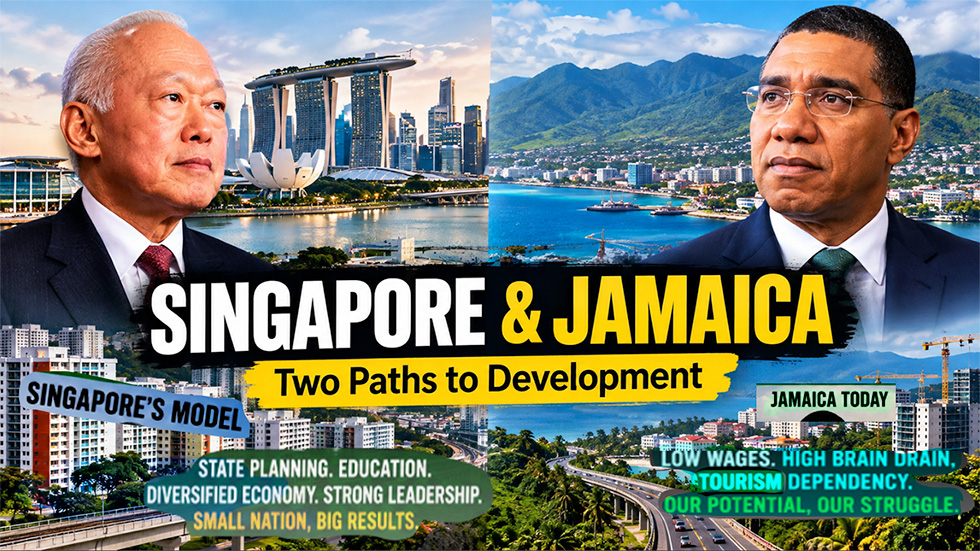
Singapore and Jamaica emerged from…
-

How a CIA-backed leader and…
-

How elite universities like Harvard…




come and join me at moomoo!Sign up via my referral link now and claim 8.1% APY and up to 15 free stocks!
account when you invite 3 or more friends to sign