Jamaica is constantly being told that the answer to economic growth is more investment.
More foreign investment.
More tourism.
More private-sector development.
More investor confidence.
And less government intervention.
But after decades of hearing the same prescription, an uncomfortable question remains:
What is Jamaica actually building for Jamaicans?
Because attracting investment is not the same thing as building a strong economy.
A country can welcome billions of dollars in foreign capital and still struggle with low wages, weak productivity, skilled workers leaving, inadequate infrastructure, housing pressures and an economy heavily dependent on a limited number of sectors.
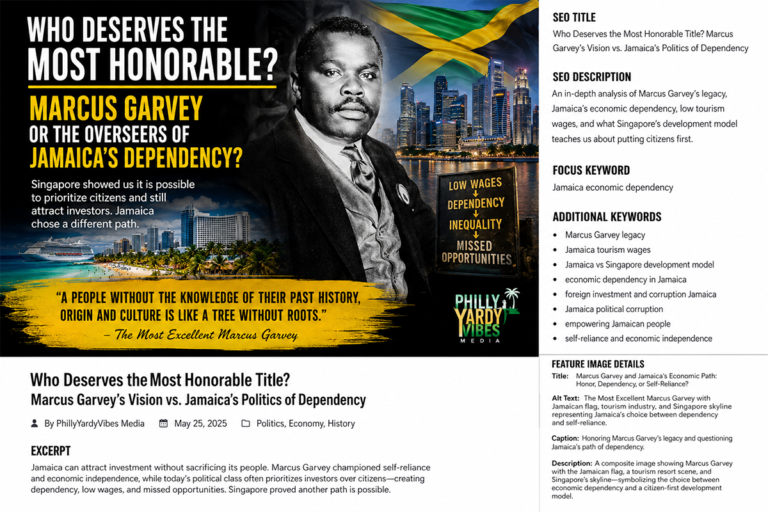
And this is where Singapore becomes interesting.
Singapore is often held up as proof of what a highly market-oriented economy can achieve.
But look more closely and another picture emerges.
The Singapore government owns and manages substantial amounts of land.
The state built an enormous public housing system.
Government-linked institutions control major pools of capital.
The country invested heavily in education, technical training and infrastructure.
And foreign investment was actively recruited and integrated into a broader national development strategy.
So Singapore did not simply say:
“Let the market handle everything.”
It used the power of the state to build the conditions under which the market could succeed.
That raises a much more uncomfortable question for Jamaica:
If Singapore used government power to build national wealth, why is Jamaica so often told that government intervention is the problem?
This is not an argument that Jamaica should become Singapore.
Jamaica is Jamaica.
Our history is different.
Our geography is different.
Our political system is different.
Our colonial experience is different.
But the comparison exposes something important.
Maybe the real problem is not that Jamaica is failing to attract investment.
Maybe the problem is what Jamaica is asking that investment to accomplish—and who ultimately benefits from it.
And that brings us to the question that matters most:
What is Jamaica doing wrong?
The Holness Development Model: Investment First
Under Prime Minister Andrew Holness, the Jamaican government has placed considerable emphasis on attracting investment, expanding tourism, improving infrastructure and strengthening investor confidence.
That raises an important question.
What happens when investment becomes the central measure of economic success?
Investment figures can rise.
Hotel rooms can increase.
Tourist arrivals can grow.
New roads can be built.
Major projects can be announced.
But those numbers do not automatically tell us whether the average Jamaican is becoming wealthier, more productive and more economically secure.
That requires a different set of measurements.
Are wages rising faster than the cost of living?
Are more Jamaicans moving into higher-skilled jobs?
Are Jamaican-owned businesses becoming larger and more competitive?
Is manufacturing expanding?
Is agriculture becoming more productive?
Are young Jamaicans staying because they see a future at home?
Are public schools and healthcare systems becoming stronger?
And perhaps most importantly:
Is Jamaica building productive assets that ordinary Jamaicans can ultimately own?
This is where the Singapore comparison becomes uncomfortable.
Singapore also pursued investment aggressively.
But investment was accompanied by deliberate efforts to build housing, education, infrastructure, technical skills and state-linked economic institutions.
The lesson is not that Jamaica should copy Singapore.
The lesson is that investment by itself is not a development strategy.
It is a tool.
The real question is what the government does with that tool.
Jamaica Does Not Need to Become Singapore
Jamaica does not need to become Singapore.
And Jamaica should not pretend that simply copying Singapore’s policies would solve our problems.
But Jamaica does need to confront a fundamental question.
What kind of economy are we actually building?
An economy where foreign investment grows while Jamaican ownership remains limited?
An economy where tourism expands while too many communities remain dependent on low-wage service work?
An economy where fiscal discipline improves the numbers on paper but public institutions struggle to keep pace with the needs of the population?
Or an economy designed to build the productive capacity, skills, ownership and wealth of the Jamaican people?
Singapore’s lesson is not that socialism is the answer.
It is not that capitalism is the answer either.
The lesson is that labels do not build countries.
Institutions do.
Strategy does.
Investment in people does.
Long-term planning does.
And perhaps most importantly, development requires asking who actually benefits from economic growth.
Jamaica has spent decades being told to attract more investment.
Maybe it is time to ask a different question.
Investment for whom?
Because the ultimate measure of economic development cannot simply be how much money enters Jamaica.
It has to be whether that money helps build a Jamaica in which more Jamaicans can own, earn, produce, innovate and prosper.
That is the question behind the Singapore comparison.
And it is a question Jamaica can no longer afford to avoid.

come and join me at moomoo!Sign up via my referral link now and claim 8.1% APY and up to 15 free stocks!
account when you invite 3 or more friends to sign