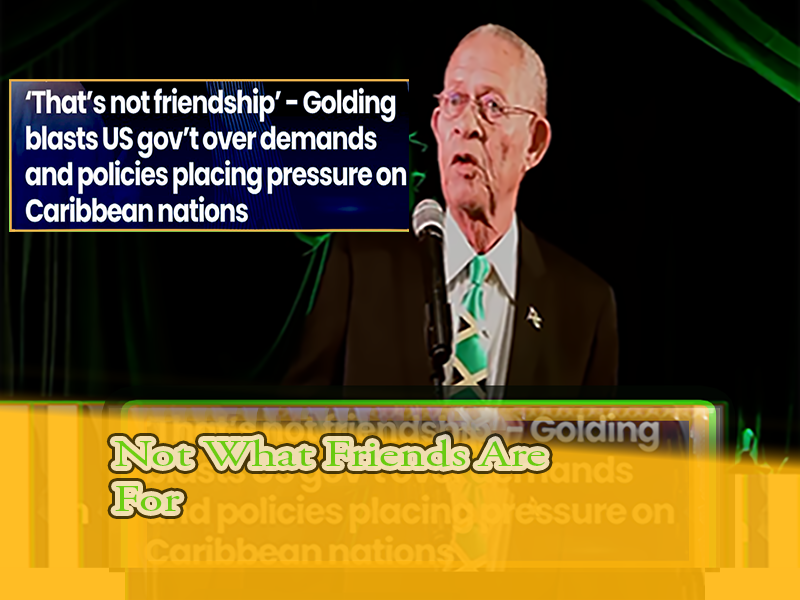
Not What Friends Are For
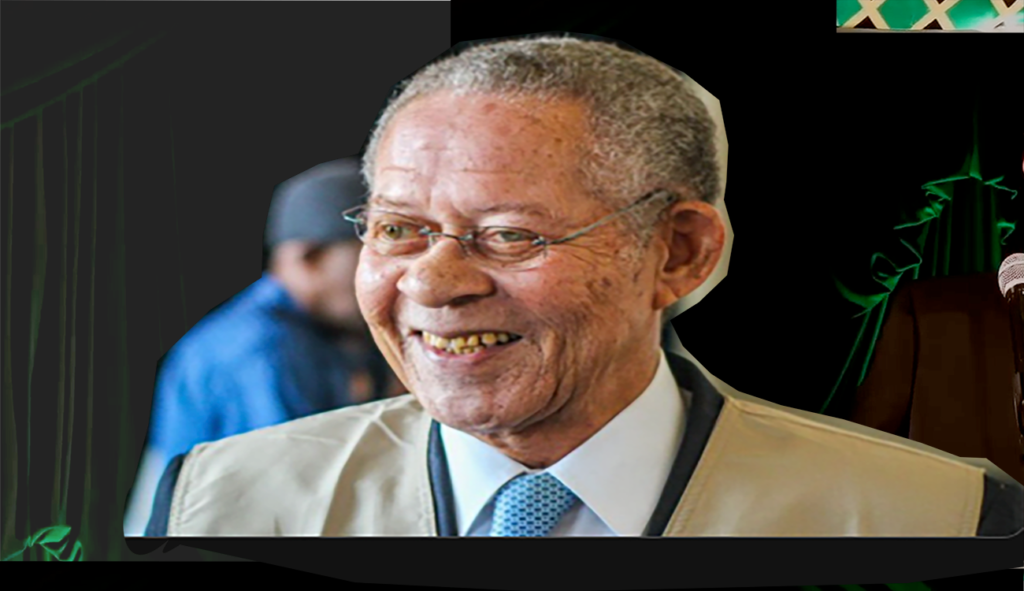
In a blunt and unvarnished assessment of Washington’s recent posture toward the Caribbean, former Jamaican Prime Minister Bruce Golding has issued a stark warning: the United States is treating its neighbors like adversaries, not allies, and the region is running out of room to maneuver.
Speaking in early August 2026, Golding did not mince words. He characterized recent American demands toward Jamaica and the wider Caribbean as coercive, heavy-handed, and fundamentally at odds with the spirit of partnership. The message was as personal as it was political: “That is not what friends are for.”


When “Friendship” Feels Like a Threat
Golding’s sharpest critique centered on the nature of the demands themselves. In his view, genuine allies do not dictate terms through intimidation. He argued that Washington’s current approach—what he described as holding a “gun to our head”—betrays the very idea of mutual respect that should underpin U.S.-Caribbean relations.
For small island nations whose economies are tightly woven into global trade networks, the threat is not abstract. It is existential. Golding made clear that unreasonable ultimatums from a superpower do not foster cooperation; they breed resentment, instability, and a dangerous sense of vulnerability among populations already grappling with inflation, climate vulnerability, and limited fiscal space.
The “Angry Lion” Dilemma
Perhaps the most vivid image Golding offered was that of the “angry lion.” Caribbean governments, he cautioned, must tread carefully. A wrong word, a defiant vote at an international body, or a perceived snub could trigger disproportionate economic retaliation from Washington. In a region where remittances, tourism, and trade preferences often hang by a diplomatic thread, the cost of standing up to pressure can be devastating.
This creates a paralyzing paradox. Caribbean leaders are elected to defend their nations’ sovereignty and advance their peoples’ interests. Yet when expressing those interests conflicts with American preferences, the consequences can be swift and severe. Golding’s metaphor captures the anxiety of governing in the shadow of a giant: you cannot outrun the lion, but you cannot afford to provoke it either.
The Geopolitical Tightrope
Golding also spotlighted the impossible balancing act that defines modern Caribbean diplomacy. On one side, there is the historical, cultural, and economic pull of the United States. On the other, there are deepening partnerships with nations like China and Cuba—relationships that offer infrastructure investment, medical cooperation, and alternative trade arrangements that Washington often views with suspicion.
For Jamaica and its neighbors, choosing sides is not a luxury they can afford. These are pragmatic governments managing pragmatic problems: crumbling roads, energy costs, public health systems, and debt. If Beijing or Havana offers a hospital, a port, or a scholarship program that Washington will not, refusing it on geopolitical grounds is a disservice to the electorate.
Yet that pragmatism is increasingly framed by Washington as disloyalty. Golding’s remarks suggest that the Caribbean is being forced into a false binary—with us or against us—that ignores the complex realities of small-state survival. Sovereignty, in this context, is not a rhetorical flourish. It is the daily work of keeping hospitals open, lights on, and food affordable.
Why This Matters Now
Golding is no longer in office, but his voice carries weight. As a former head of government who navigated Jamaica through the 2008 financial crisis and complex diplomatic waters, he understands the machinery of power from the inside. His decision to speak out publicly signals that current pressures have crossed a line that even seasoned statesmen can no longer ignore in silence.
The timing is significant. With global supply chains shifting, great-power competition intensifying, and climate finance promises still unfulfilled, the Caribbean finds itself squeezed between forces it did not create and cannot control. Golding’s intervention is a reminder that the region is not a chessboard for superpowers—it is home to millions of people whose futures should not be collateral damage in someone else’s ideological war.
A Call for Recalibration
At its core, Golding’s message is a plea for recalibration. The United States, he implies, risks alienating its closest neighbors not through neglect, but through overreach. Friendship, in the Caribbean context, has always meant something specific: respect, space to disagree, and support that does not come with strings sharp enough to cut.
If Washington continues down this coercive path, it may discover that the loyalty it demands is the very thing it destroys. And in a multipolar world where options are multiplying, the Caribbean may begin to look elsewhere—not out of ideology, but out of necessity.
The lion may be angry. But the grasslands are wide, and the prey is learning to roam.
Follow Philly Yardy Vibes for more Caribbean news, culture, and commentary. 🇯🇲🌴

come and join me at moomoo!Sign up via my referral link now and claim 8.1% APY and up to 15 free stocks!
account when you invite 3 or more friends to sign