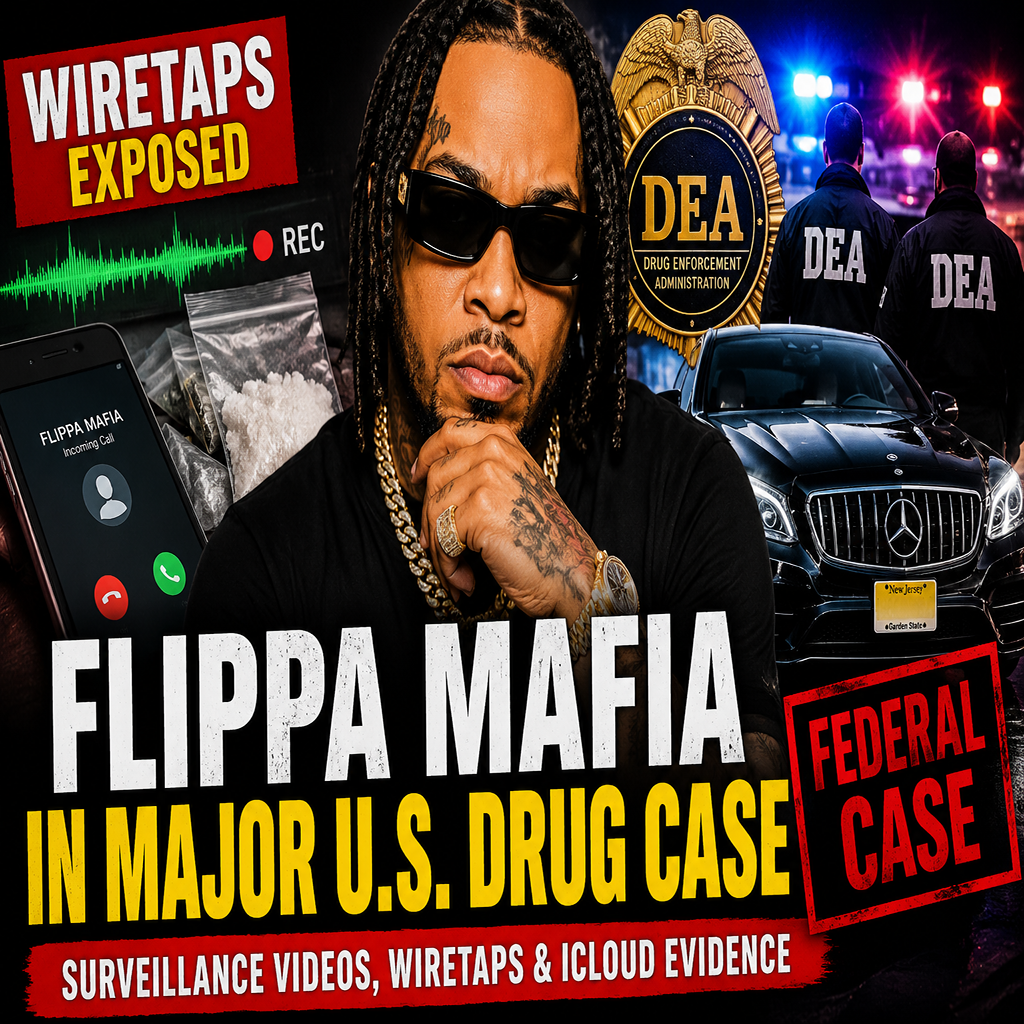
Federal prosecutors in the United States have unveiled a detailed criminal case against Jamaican dancehall figure Andrew Davis, better known as “Flippa Mafia,” alleging that the entertainer was part of a sophisticated drug distribution network operating across multiple states in the northeastern U.S.

Court filings submitted in the U.S. District Court for New Jersey claim that investigators spent months tracking the movements, communications, and alleged transactions involving Davis and several associates. The investigation reportedly relied heavily on wiretapped phone calls, covert surveillance, search warrants, and digital evidence recovered from Apple iCloud accounts.
Federal agents allege that between August 2025 and May 2026, the group conspired to distribute large quantities of cocaine, methamphetamine, and fentanyl throughout parts of Pennsylvania and New Jersey. Prosecutors described the quantities involved as substantial enough to trigger severe federal trafficking penalties.
Alongside Davis, authorities named Clifford Brown, James McBride, and Damion Jones in the criminal complaint.

According to investigators, Brown was arrested at his Pennsylvania residence on May 9, where agents allegedly discovered roughly two kilograms of suspected cocaine and nearly ten pounds of suspected methamphetamine. McBride was also taken into custody in New Jersey, where officials claim another kilogram of suspected cocaine was recovered.
Authorities have not publicly clarified the exact circumstances surrounding the arrests of Davis or Jones.
One of the most striking portions of the affidavit details a surveillance operation conducted on April 20, 2026. Federal agents claim Davis arrived at Brown’s residence in a Mercedes-Benz, briefly collected an item, and later traveled to a restaurant operated by Jones in New Jersey.
Investigators say intercepted phone calls between the men referenced a “24” transaction, which agents interpreted as a coded discussion involving approximately US$24,000 connected to a narcotics exchange.
According to the affidavit, agents observed Jones carrying what appeared to be a heavy brown paper bag toward Davis’ vehicle before allegedly retrieving another weighted bag from inside the car moments later. Prosecutors believe the exchange involved cash for illegal drugs.
The investigation reportedly went beyond physical surveillance. U.S. Magistrate Judge Sharon King approved warrants allowing investigators to monitor two cell phones connected to Davis and search data linked to his Apple iCloud account.





Federal authorities claim they recovered a video dated August 1, 2025, allegedly showing large quantities of suspected narcotics packaged in bags. Prosecutors argue the footage became a key piece of digital evidence in the broader conspiracy case.
Wiretap transcripts also revealed conversations in which Davis allegedly reflected on his previous incarceration and appeared cautious about assuming any leadership role in the alleged operation.
In one intercepted conversation, prosecutors say the entertainer referenced his earlier federal conviction and prison sentence, reportedly stating that he did not want to be viewed as “the boss” because leadership accusations previously exposed him to the possibility of life imprisonment.
The comments are significant because federal conspiracy cases often rely not only on physical evidence, but also on recorded statements used to establish hierarchy, intent, and knowledge within alleged criminal organizations.
Investigators also highlighted another intercepted conversation involving luxury spending. According to the affidavit, Davis allegedly discussed wanting to purchase a Lamborghini but expressed concern that such a high-profile acquisition could attract law enforcement scrutiny and public attention.
The case has reignited discussion both in Jamaica and within the diaspora about the long-standing relationship between dancehall culture, “flossing” lifestyles, and transnational criminal investigations. For decades, federal authorities in the United States have closely monitored Caribbean-linked narcotics networks operating along the East Coast corridor, particularly in states such as New Jersey, New York, Pennsylvania, and Florida.
The inclusion of fentanyl allegations also raises the stakes dramatically. Unlike earlier eras of cocaine-focused prosecutions, fentanyl-related charges now carry heightened political and legal urgency in the United States due to the country’s ongoing overdose crisis. Federal prosecutors increasingly prioritize fentanyl trafficking investigations because of the drug’s deadly potency and its role in thousands of overdose deaths annually.
At the same time, the case is likely to generate debate within dancehall circles about image, influence, and redemption. Davis previously served time in U.S. federal prison following earlier drug-related convictions before being released in 2022. His return to legal trouble, if proven in court, would mark another major fall for one of dancehall’s most controversial personalities.
As of now, the allegations remain accusations filed by federal prosecutors, and all defendants are presumed innocent unless proven guilty in court.




come and join me at moomoo!Sign up via my referral link now and claim 8.1% APY and up to 15 free stocks!
account when you invite 3 or more friends to sign