Earlier this week, PNP Member of Parliament Nickeshia Burchell attempted to deliver a portion of her inaugural parliamentary presentation in Patois. She was immediately “reprimanded” by House Speaker Juliet Holness, who maintained that parliamentary presentations must be delivered in Standard English. In today’s rigidly divided political environment, there is no love lost for the House Speaker among PNP loyalists; the ensuing vitriol provided a stark reminder of our current political climate. Truth be told, Mrs. Holness’s correction was in accordance with the House’s Standing Orders.
Let us establish one thing clearly and honestly from the outset: Jamaican Patois is not officially recognized as a language in Jamaica. Full stop. The hullabaloo that followed is simply people getting their knickers in a twist over what is, domestically, largely a non-issue.




That statement may upset some people, especially those who correctly see Patois as central to Jamaican identity and cultural expression. But feelings and constitutional reality are not the same thing. Jamaica may culturally function in Patois, but institutionally, it operates in English. Therein lies the contradiction.
The Difference Between Cultural Reality and State Recognition
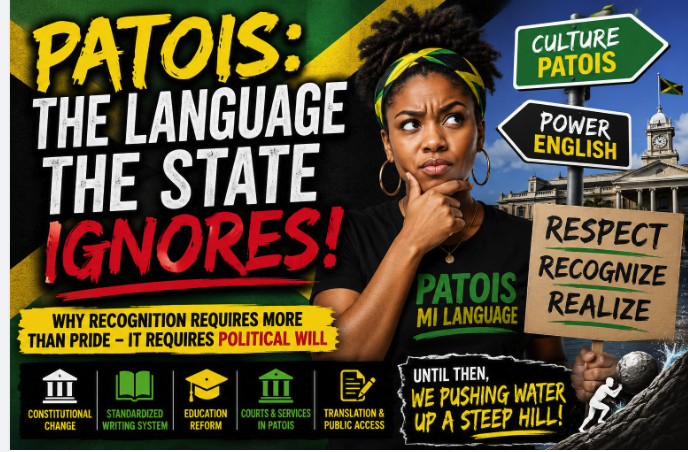
Most public arguments surrounding Patois revolve around pride, identity, heritage, and resistance to colonialism. These are valid discussions, but official language recognition is not simply about emotion or symbolism. It is a legal, constitutional, educational, judicial, and administrative undertaking of enormous proportions. To officially recognize Jamaican Patois alongside English, Jamaica would need to fundamentally restructure major parts of the State—not just tweak them, but rebuild them.
First, Parliament would have to amend the Constitution. That alone requires political consensus, legislative will, and sustained national commitment—three things Jamaica has historically struggled to maintain simultaneously. Then comes the hard part.
Recognition Requires Infrastructure
A country cannot simply wake up one morning and announce that “Patois is now an official language.” Language recognition requires systems. Jamaica would need to adopt a standardized writing and spelling structure, likely based on the Cassidy-Le Page system developed by the Jamaican Language Unit at UWI.
Dictionaries, grammar guides, and teaching standards would need to be universally institutionalized. Why? Because official languages cannot operate on “vibes” and phonetics. Right now, Jamaicans write Patois however they feel: “Mi deh yah,” “Me de ya,” and “Mi de yaa” are all common variations. This works socially, but it cannot work in court records, legislation, medical instructions, or school curricula. Standardization is mandatory, and standardization is expensive.
Education Would Have to be Rebuilt
If Jamaica were serious about official recognition, the education system would require a complete philosophical overhaul. Teachers would need retraining, and curricula would need redesigning. For generations, schools have treated Patois as “broken English” rather than a separate linguistic system. Students were often stigmatized for speaking their mother tongue. Official recognition would require a bilingual model where Patois and English are taught as distinct languages with separate grammatical systems. This is not a small adjustment; it is an educational revolution.
The Courts, Government Offices, and Public Services
Then comes the practical governance nightmare. If Patois is officially recognized, citizens must be allowed to conduct official business in it. Court proceedings, police reports, and tax documentation would all require translation and standardized linguistic accommodation. For years, Jamaica “never had enough money to stop a stale-bread cart.” Do we truly believe the State can afford this massive administrative duplication now?
The Political Class Has No Appetite for This
This is where the emotional debate crashes into political reality: neither of Jamaica’s “two political gangs” has shown any meaningful appetite for this mountain of work. There is little political reward in it. Patois is excellent for campaigns, rallies, and international branding. But institutionalizing it requires money, expertise, and political courage—a resource often in short supply when governments are already struggling with crime, healthcare, and debt. Both parties are comfortable with the current arrangement: culturally Patois, officially English. It allows them to celebrate Jamaican identity emotionally while preserving the colonial administrative structure.
A Split Society
The irony is that Jamaica is already unofficially bilingual. English is the language of authority, while Patois is the language of emotional truth. English governs the State; Patois governs the people. Because of this, Jamaica exists in a linguistic limbo where the language most Jamaicans think, dream, laugh, and suffer in remains institutionally secondary.
The Colonial Shadow
For generations, social mobility in Jamaica was tied to the mastery of Standard English. “Good English” was associated with intelligence and professionalism, while Patois was linked to a “bad upbringing.” Even today, many of the elite celebrate Patois culturally while quietly resisting its elevation institutionally. This is not an accident; it is a colonial residue.
So, What Are We Really Arguing About?
Most people arguing online are not discussing constitutional recognition; they are discussing validation and respect. While those matter, pretending we are on the verge of official recognition without addressing the administrative transformation required is simply political theater. Until Jamaica decides how much it is willing to spend and whether it has the courage to restructure its institutions, this debate will continue to be like pushing water up a steep hill.
For now, Jamaica remains exactly what it has long been: culturally Patois, officially English, emotionally bilingual, and administratively colonial.
Contributed By: Richard Hugh Blackford


come and join me at moomoo!Sign up via my referral link now and claim 8.1% APY and up to 15 free stocks!
account when you invite 3 or more friends to sign