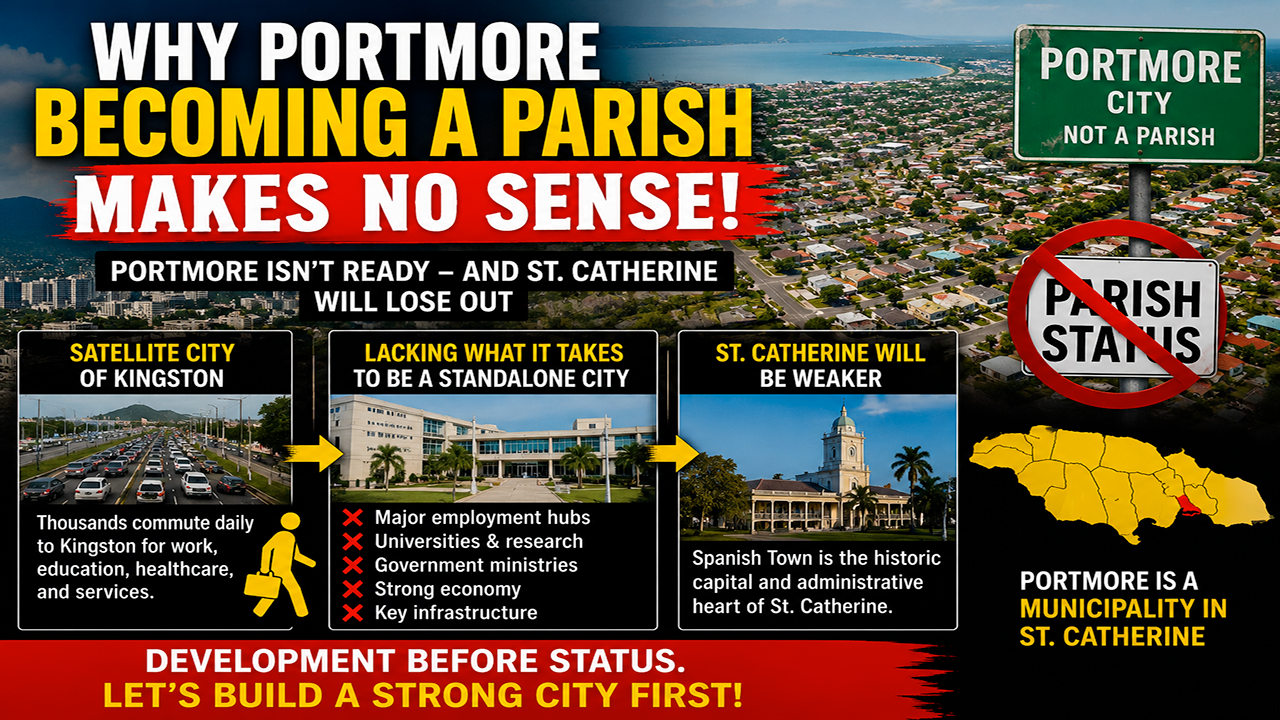
The debate over making Portmore, Jamaica’s 15th parish, continues to raise more questions than answers. While supporters argue that parish status would give Portmore greater recognition and administrative independence, the reality is that Portmore has yet to develop the characteristics of a truly self-sustaining city.
Unlike most parish capitals in Jamaica, Portmore has historically functioned as a satellite city of Kingston, built primarily as a residential community to accommodate the growing population of the Kingston Metropolitan Area. Decades later, that reality has changed very little. Every weekday, tens of thousands of residents commute across the toll road or the Causeway to Kingston, New Kingston, and St. Andrew for employment, education, healthcare, government services, and business.
Simply changing Portmore’s designation from a municipality within St. Catherine to a parish does not change these economic realities.
A Parish Without a True Capital
One of the greatest contradictions is that St. Catherine already has an established parish capital—Spanish Town, Jamaica’s former capital and one of the country’s most historic urban centres.
Unlike Portmore, Spanish Town developed as the administrative, judicial, and commercial heart of the parish. It continues to house many of the government offices, courts, public institutions, and services traditionally associated with parish administration.
If Portmore becomes its own parish, St. Catherine would lose a significant portion of its population and tax base, while Spanish Town remains the administrative centre of what is left. Rather than strengthening local government, the change risks unnecessarily weakening one of Jamaica’s largest and most important parishes.
Portmore Is Still Growing Into Its City Status
Portmore officially became a city only a relatively short time ago. Yet many residents still travel outside the municipality to access major government agencies, specialized healthcare, universities, corporate headquarters, entertainment, and large-scale employment opportunities.


A truly independent city usually possesses:
- A diversified economy.
- Strong commercial and financial districts.
- Major employment centres.
- Universities and research institutions.
- Government ministries and administrative offices.
- Cultural and entertainment hubs.
- Significant private-sector headquarters.
Portmore is still developing many of these features.
Today, it remains largely a commuter city whose economy is closely intertwined with Kingston and St. Andrew.
A Satellite City Cannot Simply Be Declared Independent
Around the world, satellite cities exist to complement larger metropolitan areas rather than replace them.
Portmore’s relationship with Kingston resembles many metropolitan regions where suburban municipalities rely heavily on the central city for employment, commerce, and higher-order services.
Changing municipal boundaries cannot instantly create the economic ecosystem needed to support an independent parish.
Economic independence comes before administrative independence—not the other way around.
What Happens to St. Catherine?
Another issue receiving too little attention is what happens to the remainder of St. Catherine.
The parish currently benefits from having two major urban centres:
- Spanish Town (the parish capital)
- Portmore (the largest municipality)
Removing Portmore would significantly reduce St. Catherine’s population, economic output, and political importance.
Instead of creating two stronger administrative regions, Jamaica could end up with one weakened parish and another that still depends heavily on Kingston.
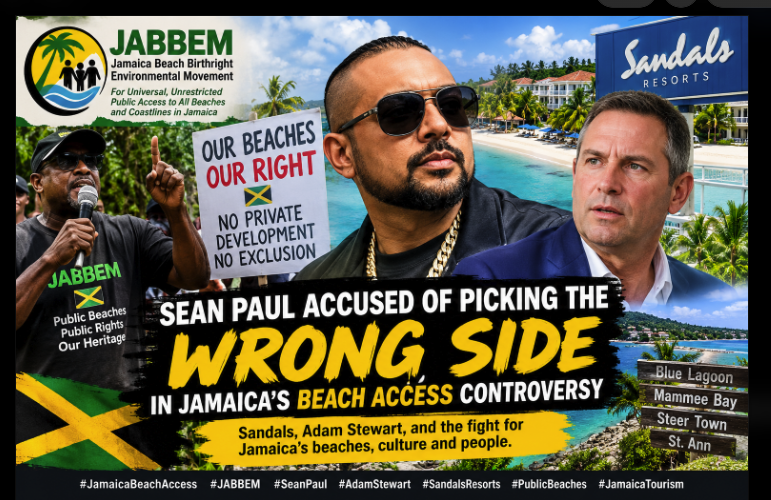
Sean Paul Accused of Picking the Wrong Side in Jamaica’s Beach Access Controversy

Sligoville Shootout: The 10-Year-Old Girl Is Alive, but Serious Questions Remain About How the Police Operation Was Handled

Jamaica-Born Sandals Enters $6 Billion Partnership as Royal Caribbean Takes 50% Stake
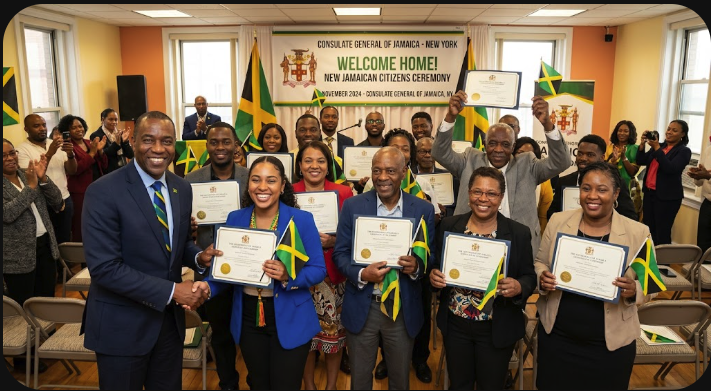
Reclaiming Heritage: 24 New Jamaican Citizens Welcomed in New York

17-Year-Old Holy Trinity High School Student Dies in Tragic Kingston Three-Vehicle Crash

Prison Altercation Between Sean “Diddy” Combs and Jamaica’s “Dudus” Coke
Kingston Is the Real Regional Centre
Many supporters compare Portmore’s becoming a parish to Kingston’s parish status.
However, Kingston is fundamentally different.
Kingston is Jamaica’s capital city, home to Parliament, government ministries, financial institutions, diplomatic missions, major hospitals, universities, and the country’s principal business district. It functions as the national administrative and economic centre.
If any constitutional reform were to be considered, one could argue that Kingston should be treated more like Washington, D.C. in the United States—a standalone capital district—rather than using it as a model for creating additional parishes.
Portmore simply does not occupy the same role within Jamaica’s national framework.
Governance Should Follow Development
Creating a new parish should be driven by genuine administrative necessity, economic maturity, and broad public consultation—not simply by political legislation.
A parish should be capable of sustaining its own institutions, attracting investment, providing employment, and functioning as an independent regional centre.
Portmore undoubtedly has tremendous potential. It is one of Jamaica’s fastest-growing urban areas and could eventually evolve into a fully self-sustaining city. But many would argue that the priority should first be expanding its economic base, strengthening its institutions, improving infrastructure, attracting corporate investment, and creating more local jobs.
Only then would parish status reflect an existing reality rather than attempting to create one by legislation.
In the end, the real question is not whether Portmore deserves recognition. The question is whether changing its administrative status will solve any of its fundamental challenges—or simply create a new parish that remains economically and functionally dependent on Kingston while diminishing the historic Parish of St. Catherine.




come and join me at moomoo!Sign up via my referral link now and claim 8.1% APY and up to 15 free stocks!
account when you invite 3 or more friends to sign