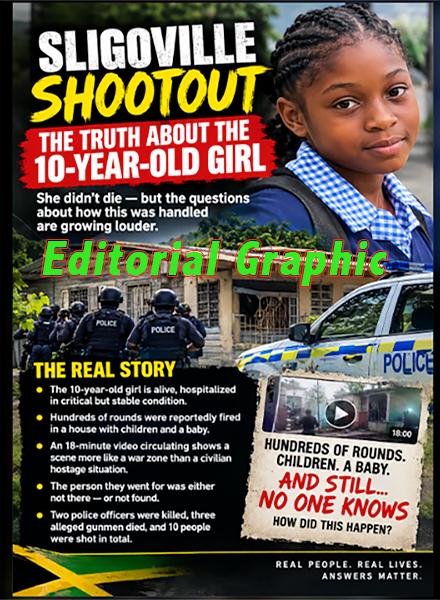
The 18-minute video, the reported volume of gunfire, the deaths of two police officers and three alleged gunmen, and the presence of children inside the house have intensified calls for answers.
The deadly police operation in Sligoville, St Catherine, has left Jamaica confronting two painful realities: the danger faced by police officers confronting armed criminals and the urgent need to examine how security operations are conducted when innocent civilians, including children, are caught in the middle.
At the centre of the controversy is a 10-year-old girl who was shot during the October 16, 2026 confrontation. Conflicting reports and rumours circulated in the immediate aftermath, including claims on social media that the child had died. However, reports from Jamaican media and official statements subsequently confirmed that she survived the shooting and remained hospitalised in critical condition. The latest information supplied for this article describes her condition as critical but stable.
Her survival is welcome news, but it does not erase what happened. Instead, the circumstances surrounding her injuries have raised difficult questions about the decisions made during the operation, the volume of gunfire reportedly unleashed, and whether every reasonable precaution was taken to protect the civilians inside the house.
According to the Jamaica Constabulary Force (JCF), officers went to the Five Miles area off the Sligoville main road to apprehend wanted men. The operation escalated into a prolonged armed confrontation involving the police, alleged gunmen and, subsequently, members of the Jamaica Defence Force.
The consequences were devastating. Two police officers, Corporal Trevoy Shaw and Constable Devoney Rose, died, three alleged gunmen were fatally shot, and multiple people were injured. The Independent Commission of Investigations (INDECOM) reported that ten people sustained gunshot wounds during the incident.
These are not minor details in an ordinary crime report. They represent a serious loss of life, a wounded child, injured security personnel and a community left searching for answers.
The Rumours About the 10-Year-Old Girl: What Is Actually Known?
In the aftermath of a violent incident, information can spread faster than it can be verified. That appears to have happened following the Sligoville shootout, when reports circulated that the young girl had succumbed to her injuries.
The Jamaica Gleaner initially reported that the child had died, but subsequently corrected its report, confirming that she remained hospitalised in critical condition. The distinction matters because inaccurate information about a child’s death can inflict additional distress on relatives and the wider community.
The responsible approach is to rely on confirmed updates rather than viral posts, forwarded messages or claims from people who may not have direct knowledge of the child’s condition.
The girl was reportedly among the occupants of the house when the confrontation unfolded. Accounts of the incident indicate that she was shot and eventually found by the police after leaving the house.
How she was injured, the precise circumstances in which she was exposed to gunfire, and whether the tactical decisions made during the confrontation increased the danger to her are questions that require a careful, evidence-based investigation.
Her condition should not become an excuse for speculation or political point-scoring. She is a child who should never have had to experience such an ordeal.
The 18-Minute Video Has Changed the Conversation
One of the most significant developments is the circulation of an approximately 18-minute video recorded during the confrontation.
Reporting by the Jamaica Observer indicates that the recording, captured during a WhatsApp video call, contains audio and footage from inside the house. The video reportedly includes children and other occupants communicating during the standoff, with a child heard pleading amid the gunfire.
Radio Jamaica News also reported that people inside the house could be heard discussing surrender with members of the security forces. The recording has prompted renewed scrutiny, and the Police High Command has been reviewing the footage.
The video is important because it offers a glimpse into events from the perspective of people inside the house, rather than relying exclusively on statements made after the operation.
However, it is equally important to recognise its limitations. The footage reportedly contains interruptions, and an 18-minute recording cannot necessarily establish everything that happened before, during or after the confrontation. It must be assessed alongside ballistic evidence, forensic findings, communications, officers’ accounts and other available recordings.
Nevertheless, the footage raises questions that deserve serious answers.
If people inside the house were communicating with the security forces and expressing a desire to surrender, what options were considered for bringing the confrontation to a peaceful conclusion? How clearly could officers distinguish between a genuine surrender attempt and a possible ambush? What steps were taken to establish the locations of the children and other civilians before further gunfire was exchanged?
These questions should not be dismissed simply because the police say the alleged gunmen were dangerous. Nor should the video be treated as conclusive proof that the officers acted improperly. It is evidence that must be examined independently and in full context.
Hundreds of Rounds, Children and a Baby: Was This the Only Way?
One of the most troubling concerns raised about the incident is the reported volume of gunfire during a confrontation inside and around a house occupied by civilians, including children and a baby.
Descriptions of hundreds of rounds being fired have intensified public concern. The precise number of rounds discharged, who fired them, and at what points during the confrontation should be established through the investigation rather than accepted as settled fact.
But even before the final count is known, the central question remains: how should an armed operation be managed when officers know, or have reason to believe, that children and other non-combatants are inside the building?
Police officers have a difficult and dangerous responsibility. They must protect themselves, members of the public and their colleagues when confronted by armed suspects. The deaths of Corporal Shaw and Constable Rose are a tragic reminder of the risks they face.
The Jamaica Constabulary Force has alleged that the gunmen used a child as part of a false surrender attempt and opened fire when officers approached. If established, that would represent a particularly reckless act that placed both the child and the officers in grave danger.
But the allegation must be examined alongside the available evidence, including the video and the accounts of those inside the house.
The presence of armed suspects does not remove the responsibility to protect innocent lives wherever reasonably possible. Nor does the presence of civilians mean officers must simply abandon an operation and allow armed men to escape.
The difficult task is to assess whether the tactics used were proportionate to the threat, whether alternatives were reasonably available, and whether decisions were made with adequate consideration for the people trapped inside.
When a house contains children and a baby, the stakes are exceptionally high. Every decision to continue an exchange of gunfire carries consequences that extend far beyond the intended targets.
If hundreds of rounds were indeed fired, the public deserves to know why that level of force became necessary, how the firing unfolded, and what efforts were made to reduce the danger to the civilians.
A Civilian Hostage Situation or a Battlefield?
Watching the circulating footage, some viewers may come away with the impression that the scene resembled a battlefield more than a controlled operation to apprehend wanted suspects in a civilian home.
That impression is understandable, given the reported length of the confrontation, the sounds of sustained gunfire, the presence of children and the tragic outcome. But an impression formed from a partial recording is not the same as a complete factual account.
The appropriate question is not whether the operation looked dramatic. It is whether the tactics employed were necessary, proportionate and consistent with the applicable procedures for a confrontation involving armed suspects and civilians.
A residential building is not an isolated battlefield. It is a place where families live, where children may be unable to understand what is happening, and where frightened occupants may have little control over the actions of armed people around them.
If suspects are refusing to surrender, officers may face an extraordinarily difficult situation. If suspects are signalling surrender while continuing to pose a threat, officers must assess that danger carefully. And if civilians are being used as human shields, the need for sound judgement becomes even more urgent.
This is precisely why training, communication, command decisions and tactical planning matter.
The public should not prejudge officers who were operating under fire. Equally, the public should not be expected to accept every aspect of an operation without scrutiny simply because it involved dangerous suspects.
Accountability is not hostility toward the police. It is part of ensuring that the public can have confidence in the police.
The Question of the Intended Target: Was the Person They Went For Actually Found?
Another concern raised in public discussion is whether the particular wanted person the police intended to apprehend was actually present or found during the operation.
That question needs to be answered with evidence. The initial reports describe an operation targeting wanted men, but the identities of all the deceased men and the circumstances of the intended arrests must be established through reliable official information.
The question is straightforward: Who exactly were the police seeking to apprehend, what information led them to the house, and was the intended target among those who were found?
If the intended person was not there, or was not apprehended, the public deserves a clear explanation of what the operation achieved in relation to its original objective. If the person was present, authorities should explain the evidence supporting that conclusion and what happened to the intended target.
This is not an argument that officers should have known in advance that a confrontation would occur. Nor does the failure to apprehend a particular suspect, by itself, prove that an operation was unjustified.
However, when an operation ends with two police officers dead, three alleged gunmen killed, a child critically injured and several other people wounded, it is reasonable to ask whether the intelligence was reliable, whether the risks were properly assessed and whether the outcome matched the operation’s intended purpose.
A transparent account of the original objective and the evidence gathered at the scene would help the public understand what happened.
How Many Weapons Were There? The Evidence Must Settle the Question
Public discussion has also raised questions about the number of weapons allegedly possessed by the men inside the house and whether the scale of the response matched the threat.
Any claim that there was only one weapon should be treated cautiously until the evidence is established. INDECOM reported that two weapons recovered in connection with the incident were photographed, packaged and sealed for ballistic examination. The commission also reported examining more than 70 service weapons belonging to members of the JCF and JDF as part of its investigation.
Those figures do not, on their own, establish how many weapons the alleged gunmen possessed or how many were fired. The service weapons were being documented for investigative purposes, while the two recovered weapons were also being examined.
The distinction is important.
The public needs a clear account of the weapons recovered, their ownership or association, the ballistic evidence, and whether the available evidence supports the accounts given about who fired at whom.
A transparent forensic report could help establish the sequence of gunfire and test competing accounts of the confrontation. Until those findings are available, claims about the exact number of weapons should not be presented as proven fact.
The Deaths of Two Police Officers Must Not Be Forgotten
Any examination of the police operation must acknowledge the deaths of Corporal Trevoy Shaw and Constable Devoney Rose.
They were officers who lost their lives during an operation that, according to police accounts, involved armed suspects who posed a serious threat. Their families, colleagues and communities deserve sympathy and respect.
Their deaths also reinforce the need to understand exactly how the confrontation developed. A proper investigation should examine the risks officers faced, the intelligence available to them, the decisions made by commanders and the circumstances in which officers were shot.
There is no contradiction between mourning fallen officers and demanding accountability. In fact, a thorough investigation can help identify lessons that may protect both officers and civilians during future operations.
If there were failures in planning, communication, training or tactical execution, identifying them would not diminish the sacrifice of the officers who died. It could help prevent another family from enduring a similar loss.
Likewise, if the evidence establishes that the officers acted appropriately under exceptionally dangerous circumstances, the findings should make that clear.
The objective should be truth, not a predetermined conclusion.
INDECOM Must Follow the Evidence Wherever It Leads
The Independent Commission of Investigations has confirmed that it is conducting an investigation into the Sligoville incident.
In its October 16 statement, INDECOM said ten people, including civilians and members of the security forces, sustained gunshot wounds. It also reported that three civilian men were fatally shot and that two minors were among those injured.
The commission said investigators and crime-scene examiners had carried out extensive work at the scene, including documenting and securing weapons for ballistic examination. It also made clear that the investigation remained ongoing.
That independent examination is essential.
The investigation should establish the timeline of the operation, the intelligence behind it, the circumstances in which gunfire began, the sequence and volume of shots fired, the location of the civilians, the injuries sustained and the actions taken to secure the release or rescue of the people inside.
The circulating video should be preserved in its original form, authenticated and examined alongside other evidence. Investigators should establish what happened during gaps in the recording rather than assuming that the footage tells the entire story.
The public should also be informed, when it is appropriate to do so, about the progress and conclusions of the investigation.
There may be legitimate reasons why certain evidence cannot immediately be released. But protecting an investigation’s integrity should not become a permanent substitute for explaining its findings.
Jamaica Needs Answers, Not Rumours or Blind Allegiance
The Sligoville tragedy should not become another controversy in which Jamaicans are pressured to choose between automatically defending the police and automatically condemning them.
The police have a duty to confront violent crime. They also have a duty to exercise their powers lawfully and take reasonable steps to protect innocent people. Armed suspects must be held responsible for their actions, but the actions of state authorities must also be open to lawful and independent scrutiny.
Those principles are not mutually exclusive.
The same public can condemn the alleged use of a child as a human shield, mourn the officers who died, demand justice for the injured girl and insist that the police operation be examined independently.
The questions raised by the video are not answered by simply labelling the suspects dangerous. Nor are they answered by assuming that every decision made by the security forces was wrong.
They require evidence, careful investigation and a willingness to confront whatever the facts reveal.
The most important issue is not which side wins the public argument. It is whether the truth can be established, whether any wrongdoing is identified and whether lessons are learned that could prevent a similar tragedy.
Conclusion: The Child Survived, but the Questions Remain
The 10-year-old girl is alive, according to the latest information supplied for this article, but her reported critical condition is a sobering reminder of the human cost of the Sligoville confrontation.
Two police officers lost their lives. Three alleged gunmen were killed. Other people were injured. Children and a baby were reportedly inside a house where gunfire erupted and continued during a prolonged standoff.
The 18-minute video has given the public a disturbing glimpse of the ordeal, but it cannot replace a full, independent investigation.
How many rounds were fired? What weapons were recovered? Who was the intended target? What happened during the attempts to negotiate surrender? Could different tactics have reduced the danger to the child and other civilians? And did the operation unfold in accordance with the appropriate procedures?
These are legitimate questions, and the answers matter.
Jamaica needs a police service capable of confronting violent criminals while protecting the public it serves. It also needs an independent accountability system capable of examining the most difficult incidents without fear or favour.
The deaths of the officers deserve justice. The injured girl deserves care and privacy. The other civilians deserve answers. And the Jamaican public deserves a clear, evidence-based account of what happened inside and outside that house.
Until the facts are established, the responsible position is neither blind defence nor premature condemnation. It is to demand the truth.
Editorial note: This article distinguishes confirmed reporting from allegations and questions that remain under investigation. The child’s medical status should be updated if a newer verified statement becomes available.
Related Posts
-
A U.S. resident was fatally…
-

Rushawn Patterson, accused of murdering…
-

Police make a deadly discovery…
-
A member of the Jamaican…


come and join me at moomoo!Sign up via my referral link now and claim 8.1% APY and up to 15 free stocks!
account when you invite 3 or more friends to sign